Here is the installation video!
Thursday, June 4, 2015

Tuesday, June 2, 2015


Saturday, May 30, 2015
Installation demoing in the field

Camera set up on one side of the walkway with very enthusiastic members

Not very discreet filming
Friday, May 29, 2015
Workshop Feedback
Workshop conducted on the 29th of May 2015, Friday, 1400 hours
Location: International College House at UQ
The following are the feedback received from the participants after presenting our final concept "Sound Seating".


Location: International College House at UQ
The following are the feedback received from the participants after presenting our final concept "Sound Seating".

Our very enthusiastic participants

- Attract the people with a nice sound, then once the user is comfortable, change the sound to an uncomfortable, jarring, annoying sound.
- Make the sound change based upon the user's facial expressions. Try to juxtapose their emotions.
- Make users happy with the music/sounds
- Need an incentive for users to sit down on the sound seating.
- Make sure bench is different from the other ones, give your target users reasons to interact with the installation.
- Make the bench look unique, to encourage people to sit, as if it looks like an ordinary bench, potential users can walk past it, or just look at it, instead of interacting with it.
- Place signage across from the bench, or down on the ground, with a message, to allow users to reflect upon the installation and the thesis.
- The interaction with this installation is passive.
- Perhaps you should interview the users after experiencing the installation.
- Write adjectives on buttons that user's can interact with, however, do the opposite of their desired action. e.g. User presses the 'Happy' button, but a sad, melancholic sound plays instead.
- Divide the bench into sections, where the sound changes in volume, intensity, sound type, based on where they are seated on the bench.
- Use chalk to mark things, or use permanent marker with tape.
Workshop Plan
Roughing out plans in the tutorial

Finalized workshop plan

Finalized workshop plan
Time
|
Activity
|
Materials
|
Outcome
|
0:00
|
Introduce the purpose of this workshop
|
n/a
|
None
|
0:05
|
Divide participants into pairs or groups of three (depending on the number of participants)
|
n/a
|
Create group interaction.
|
0:10
|
Present existing installations. Get users to choose an installation they think is most interesting. Get them to write aspects that attracted them to it.
|
Photographs of existing installations, pens and paper.
|
Insight on what attracted the users to the chosen installations.
|
0:15
|
Get the participants to come up with a rough installation concept that includes the aspects that they thought were interesting.
|
Pens and paper
|
Iterate on concept and identify aspects that would make the public engage with our installation.
|
0:20
|
Present our final concept
|
Printed copies of concept card
|
Effectively convey our idea
|
0:25
|
Ask participants to brainstorm ideas that would make installation more appealing and list three on paper. Discuss their reactions and reflections of concept and present.
|
Pens and paper
|
Gain ideas to improve concept.
Insight into how users react/understand the purpose of the installation.
|
0:30
|
Thank participants for attending workshop
|
Thursday, May 28, 2015
Sound Library Resource for Installation
In looking for sounds to use with our installation, I came across the following online libraries that we can make use of.
http://www.soundboard.com
http://freesound.org
http://makerbook.net/audio/
http://www.soundboard.com
http://freesound.org
http://makerbook.net/audio/


Wednesday, May 13, 2015
Meeting #2
Meeting #2 Minutes
Meeting time and date: 14:00, 13th May 2015, Wednesday
Members absent: None
Location: GP South, ITEE learning centre
Topic 1 - To-do list
Team made a to-do list of the all the things that needed to be done for Phase 1 of Project 2 that's due this Friday. After the list was made, the team discussed the division of workload and allocated daily goals leading up to the due date.
Topic 2 - Concept maps
We came up with four concept maps to map the existing installations that we have found. Each concept map had significantly different aspects.
Topic 4 - Concept cards
The 18 concept cards are not complete so as a team we discussed and refined each one of our ideas and provided constructive criticism to help improve them.
Meeting time and date: 14:00, 13th May 2015, Wednesday
Members absent: None
Location: GP South, ITEE learning centre
Topic 1 - To-do list
Team made a to-do list of the all the things that needed to be done for Phase 1 of Project 2 that's due this Friday. After the list was made, the team discussed the division of workload and allocated daily goals leading up to the due date.
Topic 2 - Concept maps
We came up with four concept maps to map the existing installations that we have found. Each concept map had significantly different aspects.
Topic 4 - Concept cards
The 18 concept cards are not complete so as a team we discussed and refined each one of our ideas and provided constructive criticism to help improve them.
Concept Maps
During our second out-of-class meeting, we came up with different concept maps to map the existing installations we've found. Mapping these existing installations acted as a guide for us to improve and refine the concepts we came up with, the maps also gave us an idea as to which areas we'll need to cover to satisfy certain criteria.


Site Survey- King George Square
King George Square

King George Square is located in the centre of the CBD very
close to Queen Street Mall. It is home of the Brisbane City Hall and is a major
gateway for public entering and exiting the city with a large bus station
beneath it. The square has a lot of open space which is a possible site for
implementation of an installation. The site is the centre of the square where
people walk through. 
The bus station is reason for much human traffic especially during
peak hours including early mornings and late afternoons. People also pass
through in groups according to the traffic lights at the Adelaide street crossing.

King George Square is used by the public as a meeting space
and is also a tourist attraction including statues. The area also includes some seating and a restaurant
which attract people to wait, rest or eat.

There are a variety of people who pass through King George
Square at different times of day. The early morning between 7:30 and 9am would
be business people and city staff. They are most likely tired and in a rush to
get to work on time. 
During the day the area would be filled with adults having coffee
or families exploring the city. There would also be university students coming
to the city after their class or in a break. These people would be more relaxed
and will not have time major time constraints allowing them to dedicate their
time to paying attention to detail and observation and investigating an
installation if one were to be installed. At lunch time the square would be busier with
people walking to the city for lunch. This would be a good time to use as there
is a high level of walkbys and they have time to spare.
Late afternoon is very busy for King George Square with a
large variety of people including adults finishing work, school students coming
to the city, university students, families still in the city and people going
home on buses. This would be a good time to target young school aged kids as
they would have time and are not rushing to get home.

The square is not very busy at night although it does
attract some people with the lights that decorate the area. These people
include couples going for dinner in the city or people finishing work late. These
types of people would be eager to look or interact with an installation as they
have nowhere to be and would be intrigued.
This site has most relevance to the thesis: “Public spaces
are anti-social spaces”. The site is seen to support this statement as the
space is referred to as ‘public’ and many people use this space. Although most
people are alone while walking through this space or are in a rush and like to
mind their own business. They don’t have time to stop and interact with the
many people around them that most likely have a lot in common with them. The square
does not offer anything to bring people together and is not an ideal venue for
a social gathering, especially in the day time when it is very sunny and there
is no shade. The people that have been
observed in these spaces walk alone although in a group of people. It can be
seen in the pictures that many people have earphones in or are on their phones
further preventing social interaction.
Tuesday, May 12, 2015
Overview of Theses
From the brief of Project 2:
"For this project you will be given a "critical design" brief. In teams, you will devise and construct a public installation adopts a utopian or dystopian interpretation of one of the following theses;"
Below are the theses which have been presented within the brief and statements relating to them for supporting, denying, challenging and defending.
1. "Our modern built environment drains joy from our lives"
Challenge: Our modern environment doesn't drain joy from our lives. Parts of the environment are designed to please and excite the people. From architecture to social media, people are very aware of making spaces that enhance and improve our lives with implementing green areas like parks and gardens to let people escape the dull and draining.
Deny: The modern build environment is stimulating to the senses and making us always look around to see what is constantly moving and changing around us.
Defend: The modern environment isn't designed to last. We are constantly concerned that the environment we have will fail and will need to be replaced shortly. Unfortunately it will be replaced by something inferior once again.
2. "Public spaces are anti-social spaces"
Challenge: Public spaces encourage people within them to act as part of a greater community and not just a cross section of the community.
Deny: What is the point of a public space were people are going to congregative they choose to be anti-social when they arrive?
Defend: Public spaces have become areas for people to individually go to to find space for themselves and escape other areas which they deem to be undesirable. When at these locations they choose to interact with personal devices or enjoy time alone.
3. "Society has too many prohibitions and too few invitations"
Challenge: Society doesn't involve without the advent of being asked to do something new and different.
Deny: It is not society, but people who invite themselves to change and alter their perceptions of society and limit their own prohibitions on themselves.
Defend: Without restrictions, people will start to behave in chaotic ways with no thought of the consequences of their actions over time.
Site Survey - Roma Street Parklands
 |
| Photo #1 |
 |
| Photo #2 |
 |
| Photo #3 |
 |
| Photo #4 |
Time of Visit - Mid afternoon Friday, the 8th of May, 2015
Rough demographic at time of visit: Community groups, young families, tourist group, high school students.
What were they doing: Large groups of people were around the barbecue areas and sloped shady grass areas that weren't closed for rejuvenation.
Features of the site: Large auditorium area in Photo #2. Lake with existing water feature in Photos #3 & 4. Walkway surrounding the lake. Main barbecue area is located between Photos #1 & 2 underneath walkway that links to the upper area of the parklands.
Concept map – TetraBIN
Concept map –
TetraBIN
Picture of
installation:

Description of
installation:
In some occasions, it seems that games
aren't simply used to ‘play’. It can also be that they aim to change particular
behaviors of people. Take for example this game of Tetris, designed by alumni
of the Design Lab at the University of Sydney. Their innovation, TetraBIN combines the enjoyable aspect of playing a game with a
serious, more societal-oriented aspect of behavioral change. The idea is pretty
simple: depositing trash in this special bin allows you to play Tetris.
It appears that more and more, designers and
creatives are using the city and streets for fun and excitement. These examples
of old school games implemented in our urban landscapes could be regarded as
one of the most up to date trends in circulation. However, some of them
show us that sometimes it’s not simply about the idea of playing games or
improving our public spaces. By offering an active and playful twist, people
could become more aware of their behavior in public, and, in turn, even
positively changing it.
Reference:
Concept map – Giant slides
Concept map – Giant slides
Installation picture:

Description of
Installation:
The Technische Universität München (TUM;
University of Technology, Munich; Technical University of Munich) is a research
university with campuses in Munich, Garching, and Weihenstephan. It is a member
of TU9, an incorporated society of the largest and most notable German
institutes of technology.
Located
inside the Faculty Building for Math and Computer Science are a pair of three
storey slides that descend to the first floor. Being a Math and Computer
Science facility these are actually “parabolic slides” (formula: z = y = h
x²/d²). For those proclaiming this a waste of money: according to German law, a
certain fraction of the budget for erecting a state-owned building has to be
spent on “architectural art” (German Kunst am Bau)—which, in the case of the
FMI building, are the two huge slides you can see in the picture above.
The
slides are open to visitors and are accompanied with sliding pads that are
required for using the slide. What a fun and quick way to get from the third
floor to first! If you’re ever in Munich, be sure to take a ride down these!
Reference:
concept map - Labyrinthine Staircases
Concept
map – Labyrinthine Staircase
Installation
Pictures:

Description
of Installation:
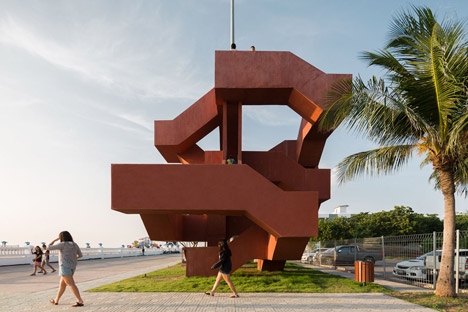
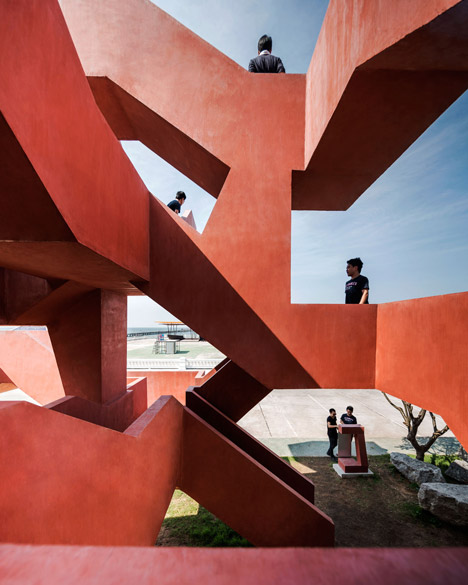
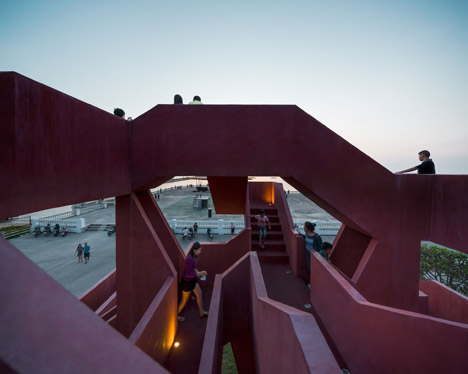
This concrete
tower of interconnecting red staircases was
designed by Thai firm Supermachine Studio. The Labyrinth was
designed for a spot on the edge of a park near Bang Saen Beach,
a coastal resort 60 miles east of the Thai capital. The concrete structure also
has the nickname 10 Cal Tower – a reference to the number of calories
expelled by a typical person ascending the stairs from base to summit. At each
level, terraces and staircases diverge to connect with different
branches of the structure, creating various routes to the summit but
also providing nooks for children to hide in during games.
"The project was started by questioning performances of
generic playgrounds today, which are facilities for the youngsters to spend
time on actively, and the adult left aside being passive," explained the
designers. "Playing hide and seek in The Labyrinth is, for us, an activity
that allows parents to spend more time with their kids," they added.
Reference:
concept map - Whisper a Message to "The Big Ear"
Concept map – Whisper
a Message to ‘The Big Ear’

Problem
Statement:
Freedom of speech is the political right of
every citizen in a democratic society to communicate one’s
opinion publicly without fear
of censorship or punishment. In today’s world, there is no
real communication between the civilians and politicians, and ‘speech’ is
simply restricted to social media. While the law makers all over the world
have shut their ears and doors to the problems of the common man, the South
Korean government is opening doors to create an effective platform for
communication.
Description
of installation:
Korean architect & artist Yang Soo-in has
designed an interactive sculpture called Yobosayo (Korean
word used to call someone’s attention, like ‘hello’), a large, ear-shaped
sculpture that records the opinions of passers-by and relays it over speakers
installed in the newly opened Seoul City Hall. The 8 feet tall sculpture has an
installed microphone inside that records the messages and each message is
then relayed through speakers located around the City Hall. Sensors on the
suspended speakers detect how many officials have heard the messages and the
amount of time people have spent in listening to the message. While the ones
that attract the most attention stay in the playlist, the unpopular ones are
transformed into music by an algorithm that amplifies and distorts their
auditory characteristics.
Reference:
Friday, May 8, 2015
Site Survey: Post Office Square


Time taken: late afternoon
Rough demographics at the time: Office workers, students, retail workers
What they were doing: Commuting home, passing by, chillin on the grass
Interesting features: Large spacious grass area, shops + eating areas


Tuesday, May 5, 2015
Meeting #1
Meeting #1 Minutes
Meeting time and date: 14:00, 6th May 2015
Members absent: None
Location: GP South, ITEE learning centre
Topic 1 - Team Charter
The team discussed sections of the charter that needed to be complete
Topic 2 - Location Scouting
Several locations have been surveyed and analysed by Craig and Andrea. Other locations pitched by the rest of the team members have been put into consideration
Topic 3 - Division of workload
The recording of meeting minutes will be taken by each member according to our last names in alphabetical order
Topic 4 - Concepts + Installations
Rough concepts were discussed, including active vs passive installations
Meeting time and date: 14:00, 6th May 2015
Members absent: None
Location: GP South, ITEE learning centre
Topic 1 - Team Charter
The team discussed sections of the charter that needed to be complete
Topic 2 - Location Scouting
Several locations have been surveyed and analysed by Craig and Andrea. Other locations pitched by the rest of the team members have been put into consideration
Topic 3 - Division of workload
The recording of meeting minutes will be taken by each member according to our last names in alphabetical order
Topic 4 - Concepts + Installations
Rough concepts were discussed, including active vs passive installations
Interactive Installations - Light Drift
Light Drift by J. Meejin Yoon was a temporary installation with the approval and support of the City of Philadelphia Mural Arts Program.
Orb shaped elements placed on the shore and in the water are illuminated by the interaction of the passers-by of the display. Different interactions with the orbs on the shore cause different responses from the orbs that are placed in the water.
References
http://www.muralarts.org/collections/projects/light-drift
Interactive Installations - Tiger & Turtle
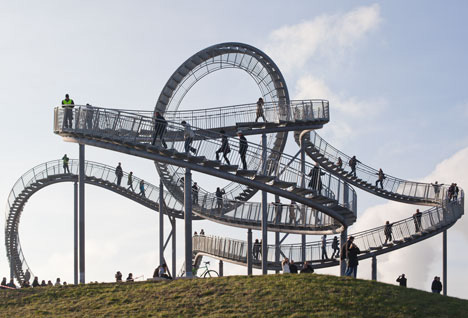
"Tiger & Turtle" is a fantastical roller coaster sculpture in Duisburg, Germany which is a 70 foot high staircase sculpture that resembles a rollercoaster the visitors are invited to walk along and explore.
The design is meant to let people reflect on the carnival rides of their youth and experience the angles and corners at a much slower speed. According to the artists, the sculpture has another meaning and message regarding the surrounding areas work towards environmental reform.
Reference
http://anatomyofabutterfly.blogspot.com.au/2011/12/playfully-serious-interactive-sculpture
Silent Lights
Silent Lights is an interactive public installation that converts traffic noise into energy, to power LED lights, that illuminates the dark area.
This installation creates an impact on the chosen environment, by creating a safe area for pedestrians to walk, while alleviating the extreme noise pollution generated in the area. It also enhances the atmosphere with the interactive LED lights.
This is an interesting, and innovative method to utilise the negatives of their chosen public area, and modifying it into positives
Interactive Installations - Cloud Gate (Chicago, USA)

Cloud Gate is a 66 feet long by 33 feet high bean shaped sculpture located at Millennium Park in Chicago, USA.
Its polished surface made to resemble mercury gives people a highly reflective surface that distorts the surrounding skyline and giving a juxtaposition of the what is behind and in front of the observer.
Being one the side of a static installation, people are still drawn to interact with the piece as it is a great photo opportunity for locals and tourists alike.
References-
http://www.cityofchicago.org/city/en/depts/dca/supp_info/millennium_park_-artarchitecture.html#cloud
Interactive Installations - 21 Balançoires/21 Swings (Montreal, Canada)
7 sets of 3 swings outside the Montreal Art Gallery which when used they create a melody. The higher you go the more notes you make and the faster you go the quicker they are played.
People are encouraged to use a set together with multiple people to create music and harmonies.
I have been on these swings and my friend got so excited using them she almost broke her ankle. True story.
Click here for more information about 21 Balançoires
Monday, May 4, 2015
Installations
1. Firewall from Aaron Sherwood on Vimeo.
Firewall is an interactive media installation created with Mike Allison. A stretched sheet of spandex acts as a membrane interface sensitive to depth that people can push into and create fire-like visuals as well as expressively play music.
The original concept stems from a performance piece I’m currently developing as Purring Tiger (with Kiori Kawai) titled Mizalu, which will premiere in June 2013. During one scene in the performance dancers will press into the spandex with the audience facing the opposite side. Mizalu is about death and experience of reality, so this membrane represents a plane that you can experience but never get through. As hard as you try to understand what’s in between life and death, you can never fully know.
The piece was made using Processing, Max/MSP, Arduino and a Kinect. The Kinect measures the average depth of the spandex from the frame it is mounted on. If the spandex is not being pressed into nothing happens. When someone presses into it the visuals react around where the person presses, and the music is triggered. An algorithm created with Max allows the music to speed up and slow down and get louder and softer, based on the depth. This provides a very expressive musical playing experience, even for people who have never played music before. A switch is built into the frame which toggles between two modes. The second mode is a little more aggressive than the first.
Firewall User Testing from Aaron Sherwood on Vimeo.
Taken from Aaron Sherwood's blog
2. Floor Quizmap

It's a very simple idea but it can be a lot of fun and engaging for customers - users can take a floormap quiz to determine that leads them to the product they want based on simple questions.
3. 'On Space Time Foam' Exhibition/Studio Tomas Saraceno


Taken from arch daily
4. Access Agency’s ‘Drink Away The Art exhibition

At an exhibit in Dresden, Germany, guests were invited to drink away the art. These beautiful multicolored liquor infusions not only add a splash of color to the decor (pun intended), but also are a perfect example of culinary interactivity within the event setting.
Taken from Design-Milk
More from Access Agency
5. The Event of a Thread - Ann Hamilton

the event of a thread is made of many crossings of the near at hand and the far away: it is a body crossing space, is a writer's hand crossing a sheet of paper, is a voice crossing a room in a paper bag, is a reader crossing with a page and with another reader, is listening crossing with speaking, is an inscription crossing a transmission, is a stylus crossing a groove, is a song crossing species, is the weightlessness of suspension crossing the calling of bell or bellows, is touch being touched in return. It is a flock of birds and a field of swings in motion. It is a particular point in space at an instant of time.
— Ann Hamilton

Subscribe to:
Comments (Atom)